Benchmark report
รายงานทดสอบความถูกต้อง
Continuous spans, signed forces, supports and reinforcement · 13 October 2026
Current result: PASS · 13 October 2026. More than 140,000 numerical assertions passed with zero failures across the continuous-beam and existing engineering suites. The continuous solver adds 90,656 assertions, 240 independent force-compatibility models, including 120 variable-section models and analytical/dense extrema checks. Continuous controls, geometry synchronization, loading and exports are also verified at 1280, 390 and 320 px.
Continuous beams / คานต่อเนื่อง · 13 October 2026
N=1 selects a single span and N=2–8 selects connected spans. Every span can have its own width, depth and reinforcement preferences. The direct stiffness method with exact per-span force and deflection recovery. The independent reference uses force compatibility and singularity integration. Cases cover unequal spans, fixed supports, overhangs, free stations, signed UDL patterns and point loads, including support reactions and both sides of shear/moment jumps.
Maximum normalized reaction, bending and deflection differences are 7.051e-11, 1.281e-12 and 7.072e-14, against tolerance 4e-8 under the recorded normalization. Twenty-four dense models sample 4,001 stations per span to check analytical extrema. The separate 51,265-assertion legacy benchmark still passes.
| Classical two-span example | Beam Studio / closed form |
|---|---|
| 4 m + 4 m, 500 kgf/m each, self-weight off | Pin / roller / roller; constant EI |
| Reactions A / B / C | 750 / 2,500 / 750 kgf = (3/8, 5/4, 3/8) wL |
| Hogging at B | −1,000 kgf·m = −wL²/8 |
| Peak sagging | 562.5 kgf·m = 9wL²/128 |
| Immediate deflection: b20 cm, h40 cm, E25 GPa, Ieff/Ig1 | 0.254947 mm |
77 continuous engineering and 50 report assertions verify physical support-gap deflection references, slenderness, near-support loads, span records and every reaction. 162 current N and variable-section browser assertions verify controls and CSV exports. Negative reactions require hold-down review. Alternating live patterns are explicit snapshots, not exhaustive adverse-pattern envelopes.
Continuous numerical results (JSON) · Continuous method and derivations · Current repeatable test bundle · Full calculation basis.
Linear elastic analysis and preliminary section checks only. Local support reinforcement, anchorage, laps, cutoffs, cracking, long-term deflection and complete Thai/ACI compliance require further design.
Support and multilayer upgrade · 12 October 2026
Pin, roller, fixed and free end selectors drive the elastic boundary conditions and drawings. Fixed–Fixed, Fixed–Pin, Pin–Fixed and cantilevers in either direction are verified against a separately assembled matrix-stiffness model. Both top and bottom tension demands are checked when bending reverses. The three-layer calculation uses the actual area centroid; an independent layer-by-layer elastic/yielding strain-equilibrium solution checks accepted capacities.
SR24 offers RB6, RB9 and RB12; other supplied sizes retain custom diameter/strength inputs. The review brief's clear-spacing rules are max(25 mm, 2db, 4agg/3) horizontally and max(30 mm, 2db, 4agg/3) vertically. Forces and moments can be displayed in kgf, metric tonne-force (tf), or kN. 1 tf = 9.80665 kN.
Maximum normalized finite-element errors: reaction 2.037e-11, moment 1.528e-11, shear 2.308e-11, deflection 4.500e-12. Tolerance: 2e-7 times the documented force, moment or deflection scale. This is mathematical model validation, not a construction-readiness or code-compliance certification.
Current numerical results (JSON) · Current repeatable test bundle · Calculation basis and validation record.
Historical validation records · 6–11 October 2026
Factory stock and grade checks · 11 October 2026
The seven pictured products are SD40 DB10, DB12, DB16, DB20, DB25 and SD50 DB16, DB20, all supplied as 12 m straight bars. Automatic recommendations and engineering comparisons use this list. Manual rows retain their selected diameter when the grade changes; unavailable rows show a stock warning and cannot pass the selected-layout checks or export a drawing.
Independent product tests cover bar area, effective depth, unit conversion, strain-compatibility flexural capacity, shear capacity, both beam support types and density-based quantities. The weights catalogue and CSV contain all seven grade/diameter combinations. Equal diameters have equal theoretical mass; the entered fy changes strength. Custom strengths retain the pictured diameters but do not establish stock-grade certification.
Thai gravity default · 10 October 2026
The default mixed strength combination is now 1.4D + 1.7L, following the gravity-only case in B.E.2566 Ministerial Regulation, Clause7(1). For the default 4 m, 200 × 400 mm simply supported example, D includes 192 kgf/m self weight: the factored UDL is 1,058.8 kgf/m, Mu is 20.76656 kN·m and Vu is 20.76656 kN. The reinforcement recommendation remains 3 DB12 with Ø8 @ 150 mm.
Independent default-preset regressions check dead self weight, both D/L point-load classes, simply supported and cantilever responses, and consistency of report factors and demands in kN and kgf. The explicit published ACI 1.2/1.6 reference case is retained. Higher default loads change the number of accepted random reinforcement alternatives, so the total assertion count changes with those alternatives. The selected section equations retain ACI-style strength factors; the gravity preset alone does not establish full Thai-regulation compliance.
Combinations, quantities & engineering reports · 10 October 2026
Editable, enabled service and strength combinations now drive diagrams and their separate design envelopes. Independent checks cover changes in the governing bending, end-zone shear and middle-zone shear cases. Nominal bar masses and detailed quantities include both longitudinal rows and unique placed stirrups. Browser verification covers factor edits, invalid-case recovery, load selection, imports/exports, units, synchronized geometry and phone controls.
Example beam engineering report (PDF) · Calculation basis and validation record. The example uses the default 4 m, 200 × 400 mm beam; create a fresh report in the calculator for your project. The example is preliminary and is not a construction design.
Engineering workspace upgrade · 07 October 2026
The earlier webpage passed the original 27,134 assertions, 31 steel catalogue assertions and 52 engineering workspace assertions: 27,217 total. Those checks cover three load cases, both steel grades, quantity formulas, duplicate point-load locations, shear jumps, stock-length limits and invalid geometry.
Browser checks verified comparison selection, reference-limit changes, CSV export, invalid-input recovery, and 320 / 390 px phone layouts. Quantity estimates exclude anchorage, laps, stirrup hooks and bend allowances. Deflection references do not establish code compliance.
Contents / สารบัญ
One real layout defect was reproduced against the previous source revision and corrected. No force-analysis discrepancy was found within the tested cases and tolerances.
Error found and corrected
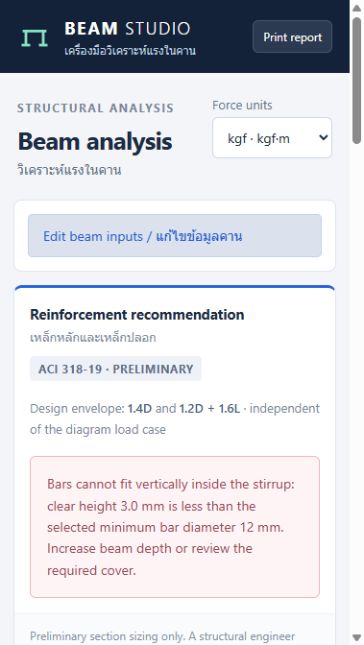
For a 261 × 215 mm section, 100 mm cover to the stirrup exterior, a 6 mm stirrup and DB12 main bars, the old version accepted 2 DB12. Only 3 mm of vertical clear height exists inside the stirrup: 215 − 2(100 + 6) = 3 mm. A 12 mm bar cannot fit.
Version 1.0.1 rejects that arrangement and explains the dimensions. The check applies to automatic and manually selected bar sizes, and to both supported beam types. Eight regressions cover the reproduced defect, the fit boundary, negative internal height, and the normal starting example. The app's calculation details now also show vertical fit for accepted layouts. This geometric check does not design stirrup hooks or bends.
Before/after evidence is recorded in Beam-Studio-Benchmark/vertical-fit-before-after.json. The previous revision was loaded directly from Git; it returned ok: true, whereas the corrected revision returned ok: false.
Independent force benchmark
Five closed-form cases cover simply supported and cantilever UDLs, midspan and eccentric point loads, and a cantilever tip load. The equations follow MIT's beam-deflection notes. The largest observed closed-form error was 1.58e-16, normalized with a minimum denominator of 1.
A separately implemented Euler–Bernoulli finite-element reference uses matrix stiffness, consistent distributed-load nodal forces, constrained degrees of freedom and pivoted Gaussian elimination. Point loads are applied at nodes. The reference uses Hermite interpolation with the exact UDL bubble term inside elements, recovers element shear/moment from element end forces, and locates peak deflection through golden-section search. It does not call the app's solver or copy its integration/extrema algorithm.
120 deterministic cases cover 60 simply supported and 60 cantilever beams; spans 0.1–100 m; zero loads, distributed loads, endpoint/interior/coincident point loads; dead/live factors including zero; optional self-weight; and varied E, section and effective-I multiplier. These are mathematical force tests; cases outside the reinforcement model's slenderness limits do not receive reinforcement certification. Comparisons include 2,520 nodal deflections, element endpoints and midpoints, reactions, peak shear, peak moment and peak deflection.
| Quantity | Maximum normalized error | As a percentage |
|---|---|---|
| Reaction | 2.972e-11 | 0.000000003% |
| Moment | 2.104e-11 | 0.000000002% |
| Shear | 2.984e-11 | 0.000000003% |
| Deflection | 6.224e-12 | 0.000000001% |
The error denominators are total applied force (minimum 1 N), that force × span (minimum 1 N·m), and force × span³/EI for displacement (minimum 1e-8 mm). The absolute comparison tolerance is 2e-7 times the corresponding scale. Peak-deflection position tolerance is 3e-6 times span. These scale-normalized errors avoid misleading percentages at zero-force locations. The seed is 0xB3A62026.
Published numeric comparisons
| Quantity | Published reference | Beam Studio | Unit | Absolute difference | Result |
|---|---|---|---|---|---|
| Mento flexural strength | 84.13000 | 84.12987 | kN·m | 0.000133 | PASS |
| Mento concrete shear φVc | 58.32000 | 58.32348 | kN | 0.003476 | PASS |
| Mento stirrup shear φVs | 102.88000 | 102.88237 | kN | 0.002370 | PASS |
| Mento total shear φVn | 161.21000 | 161.20585 | kN | 0.004154 | PASS |
| Mento shear ceiling | 284.76000 | 284.75579 | kN | 0.004207 | PASS |
| StructurePoint support shear | 32.30000 | 32.30000 | kip | 0.000000 | PASS |
| StructurePoint peak moment | 201.88000 | 201.87500 | kip·ft | 0.005000 | PASS |
The five section-strength values come from the Mento ACI 318-19 example. Section inputs are b = 200 mm, h = 500 mm, f′c = 25 MPa, fy = fyr = 420 MPa, 25 mm cover, mixed 2Ø16 + 1Ø12 bottom bars and two-legged Ø10 stirrups at 220 mm. Effective depth is recovered from the exact bar-area-weighted centroid. This checks the production section-strength functions, which are also called by the layout search. It does not reproduce that reference's mixed-bar or moment-reversal design. Those features and 25 mm cover remain outside the webpage's offered layout inputs. Published rounding tolerance is 0.015 kN or kN·m.
The force values come from StructurePoint's simply supported ACI 318-14 example: a 25 ft span, D = 0.82 kip/ft, L = 1 kip/ft and factors 1.2/1.6. The stated analyzed loads are used with automatic self-weight off. Values are compared using the exact 2.584 kip/ft factored load, so 201.875 kip·ft rounds to the published 201.88. This comparison covers forces, not that report's cracked/long-term deflection or complete bar detailing.
Reinforcement benchmark
600 seeded scenarios vary section dimensions, main-bar preferences from the pictured stock list, stirrup sizes, strengths, aggregate size, cover, self-weight, load magnitude and beam type. 107 scenarios produced an arrangement and 493 produced no acceptable arrangement.
For every accepted alternative, an independent neutral-axis equilibrium root includes elastic/yielding steel stress and verifies flexural capacity and strain. A separate bisection in steel area verifies the required area. Additional invariants check minimum main steel, clear horizontal gaps, vertical enclosure, stirrup yield capacity, minimum stirrups, longitudinal spacing, transverse leg spacing and the concrete compression limit. Maximum flexural-capacity relative difference was 5.492e-16. Rejected cases exercise failure handling; this test does not prove that every possible arrangement was searched or that every rejection is optimal.
A targeted high-shear case also exercises the tighter d/4 stirrup-spacing branch. With b = 400 mm, h = 700 mm, L = 3.5 m, f′c = 17 MPa, fy = fyr = 420 MPa and live load 14,500 kgf/m, the current 1.4D + 1.7L default selects 6 DB20 with Ø12 @ 150 mm. The computed longitudinal limit is 159.5 mm, and spacing is rounded down.
Webpage and Windows verification
The local webpage visibly rejects the reproduced 3 mm clear-height case and hides the reinforcement result. The starting example remains 3 DB12 with Ø8 @ 150 mm. The corrected warning is shown in Beam-Studio-Vertical-Fit-Check.png.
Historical Windows verification from 06 October 2026: the actual portable executable was launched in its hidden verification mode. It exited with code 0 and confirmed: packaged app True, version 1.0.1, starting bars 3 DB12, stirrups Ø8 @ 150 mm, vertical-fit regression rejected True, and UDL closed-form deflection passed True. Six diagrams rendered and both initial error panels were hidden. The web and desktop used identical solver and rebar files in that release. The legacy Windows executable has not been rebuilt for the current website upgrades.
Repeat the tests
With Node.js available, extract the supplied test bundle and open its folder and run:
node verify.cjs
node steel-catalogue.cjs
node benchmark.cjs benchmark-results.json
The repeatable test bundle and raw JSON results are available to download. The JSON contains numeric results, tolerances, case counts and failure details. The tests are deterministic except for the recorded timestamp.
Interpretation
These results support correctness of the implemented single-span elastic analysis and selected reinforcement strength/fit equations in the tested domain. They do not establish construction readiness, Thai-code compliance, or complete ACI compliance. Cracked-section stiffness, long-term deflection, crack control, anchorage/development, hooks/bends, support zones, integrity bars, seismic detailing, axial force, torsion and multi-layer reinforcement still require separate design. Material catalogue properties and complete loads must be verified for the actual project.
Historical 6 October source commit: 30e3e1002aa455989e959c816893e81fa9acf148.
Windows executable SHA-256: 531A3A300F37FDA8A6FB30B25A3D7E4C8B407825256468A192783603C779A024.